
I’ve had this cookbook sitting beside my bed for weeks, trying to decide what to cook. I’d pick it up, let a page fall open — almost like letting fate choose the recipe — and get distracted reading. It continued this way for a while. It’s my favourite way to read a cookbook.
But the problem for me is that I’m indecisive. Should I make the boozy cherries? That’s how long ago it was when I first started reading Domenica Marchetti‘s Preserving Italy (her seventh cookbook!). It was early summer. Cherries were abundant in the market, and I had just tried my own cherries in liqueur when I read Domenica’s recipe for her grandmother’s “Sour cherries in boozy syrup” and her special trick of drying sour cherries out in the oven first.
Then I saw her homemade orzata (almond syrup to stir through milk or make refreshing cocktails). Another bookmark. Her recipe for making your own guanciale (cured pork jowl, a must in dishes in pasta all’amatriciana). And — one I’ve been waiting for September for, grapes spiced in grappa. To be eaten chilled, no more than one or two, Domenica advises, as they are strong. I’m in.
For someone like me, who loves making jam and pickling, preserving seasonal vegetables in oil or experimenting with liqueurs, this book is not only loaded with ideas (that pickled vegetable pizza, yes please!) and techniques, but Domenica has done so much research in the topic that food nerds will really appreciate how technical she gets. And for anyone who has never done canning or jam-making or the like before, this is an excellent place to start. From simple strawberry jam to sweet and sour pickled onions and homemade limoncello, even homemade primo latte (a fresh cheese), Domenica guides you through these classic Italian traditions with precision and ease.
Her personal stories of trips to the Amalfi coast or Abruzzo, friends’ recipes, visiting a buffalo cheese farm in Paestum or growing up in an Italian-American household not only give the recipes a context but are a reminder of how Italian traditions of preserving are ancient, vast, so intertwined with the seasons and dealing with a glut of (what was usually homegrown) produce — an immensely important part of the culture of Italian cuisine.
I ended up going with a favourite, Tropea onion jam. It’s a delicious, savoury, jewel-toned jam that sits well on a cheese plate, which is how I often see it here in Italy, and goes beautifully with meat (Domenica uses it on her blue cheese beef burgers). Spotting a braid of Tropea onions — sweet, red onions of an oval shape — at a favourite farm market recently, I let fate decide that jam was to be made. It’s slightly spiced, with a sweet and sour tang to it and with that deep, red wine-hue, looks so pretty on a plate. I paired it with some semi-aged pecorino cheese to eat as an antipasto, aperitivo or a snack. Next I have my eye on Domenica’s brandied chestnut cream — the perfect winter treat.
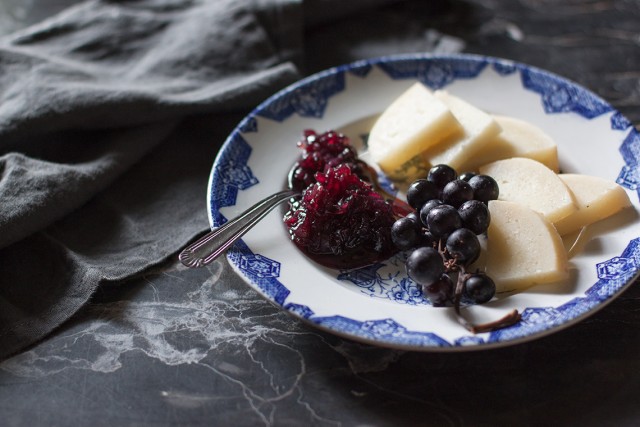
Domenica Marchetti’s Tropea Onion Jam
This is based on Domenica Marchetti’s Preserving Italy. In Domenica’s recipe, she also goes into further detail on processing jars (Water-Bath Canning), which is highly informative. The only alterations I made were to slice the onions finely rather than dice and I also used less sugar (about half), as the Tropea onions I had were naturally very sweet. As with most jams that don’t really have a pulp, watch this syrup carefully and make sure it doesn’t boil down too far or you’ll end up with a jam that is too sticky and less silky.
- 450 grams Tropea onions (or firm, young red onions), finely diced or sliced
- 400 grams sugar
- 250 ml sangiovese or other dry red wine
- 1/2 teaspoon fine sea salt
- 10 whole peppercorns
- 1 whole clove
- 1 bay leaf
- 1-inch piece of vanilla bean
- 1/2 cinnamon stick
- 2 tablespoons red wine vinegar
Combine the onions, sugar, wine and salt in a heavy-bottomed saucepan.
Place the peppercorns and other herbs and spices in a small piece of muslin/cheesecloth and tie with kitchen string for a little pouch that you can easily remove later. Add it to the pot.
Bring the mixture to a boil over medium heat. Simmer, stirring often, until the jam has thickened and reaches 220-225 degrees Fahrenheit (104-107 degrees Celsius), about 20 minutes. Domenica describes this fantastic way to tell it’s at the right stage: see if you can drag a path along the bottom of the pot with a silicon spatula. Or you can use the saucer in the freezer method (my favourite) to test for doneness — place a saucer in the freezer. Once cold, place a blob of jam on the plate and spread it out or poke it a little with your finger. The idea is the plate should make it cool quickly and you’ll be able to see how it behaves and if the jam ‘wrinkles’ or not when touched or moved. If it does, it’s done.
I used this immediately (keeping one in the refrigerator and giving the others to friends) so I didn’t process my jars, but if you want to keep it, ladle the boiling hot jam into clean jars and screw lids on tightly. Process in a water bath, remove from the water and let dry upright. Store in a cool, dark place.
Originally posted 2016-09-26 00:00:00.