
I like a good list, and particularly ones about kitchen items. There are some good lists out there on what essentials you should keep in the kitchen. Like this one from Food52 and especially this one by Rachel Roddy in The Guardian. I think partly I like them so I can fantasise about what I will have in my kitchen, one day, when I actually own one. And partly I like to “peek” into other people’s kitchens and find out their habits by knowing what items they deem essential.
Laurie Colwin’s chapter, “The Low-Tech Person’s Batterie de Cuisine”, in Home Cooking, is one of my favourite on the subject of kitchen items. “How depressing is it to open a cookbook whose first chapter is devoted to equipment. You look around your kitchen No chinoise! No flan ring! No salamander! How are you ever going to get anything cooked? What sort of a person is it who doesn’t own a food mill?”
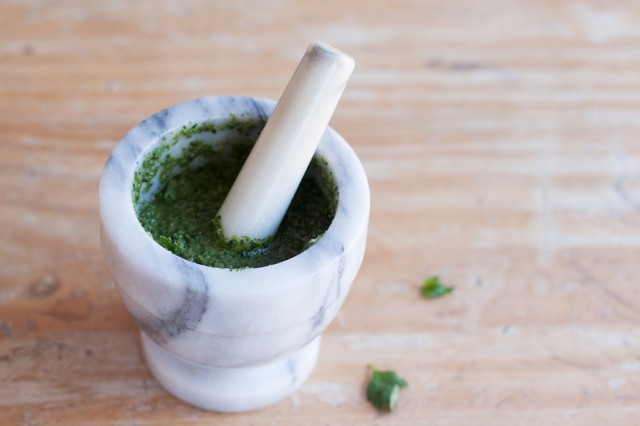
Having lived in such a nomadic state for a good part of a decade, any fancy equipment I have accumulated over the years (namely, heavy things like my set of Le Creuset pans, a Carrara marble mortar and pestle, and an ice cream machine) is packed up in a box in a relative’s garage somewhere on the other side of the world.
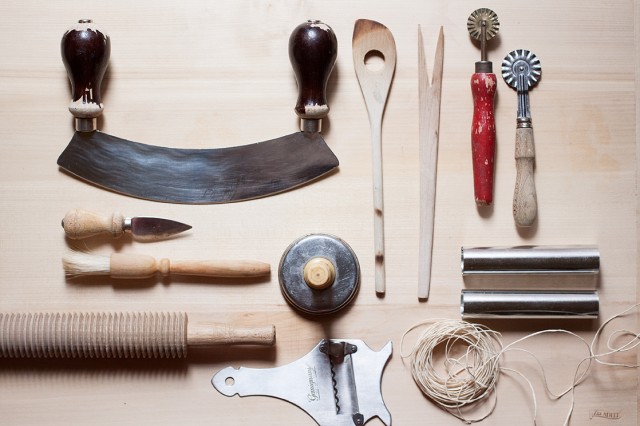
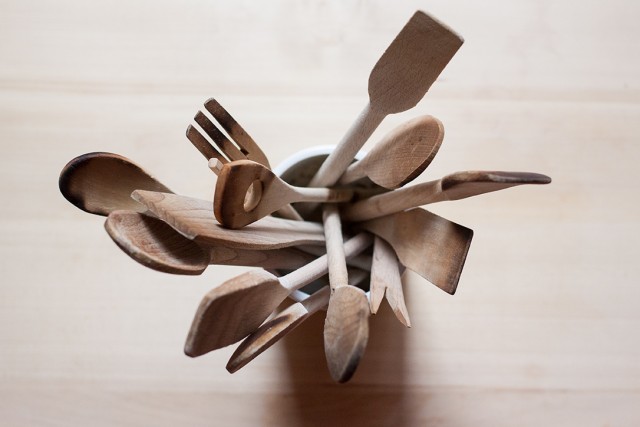
I have with me what I can roll up in dish towels and put in a suitcase. It’s as low tech as you can get (Laurie Colwin would be proud) and involves, mostly, a knife from Kappabashi in Tokyo and quite a lot of wooden instruments, in particular, wooden spoons that bear the marks of being left too long sitting on the edge of a pot, a hard-wood rolling pin with grooves for making noodles that I found in a second hand shop and a fluted pastry cutter from an antique market.
I have picked up some clutter along the way, too, though. Little things that make an appearance perhaps once a year. The truffle grater. Metal tubes for making cannoli (which, I admit, are indispensable for that job, however). A knife for cutting attractive chunks of Parmesan.
My kitchen collection began when I was a 20 year old art student in a shared flat in Florence. Unsurprisingly, it was the bare essentials. I whipped eggs with a whisk when I made pavlova, rolled pastry with a wine bottle and toasted bread on a dry frying pan. A citrus squeezer? My hand. Not much has changed, except I now own a rolling pin, but I appreciate very much being low tech. The only electric tools I use are a set of cheap beaters for whipping egg whites (thank goodness) and a hand held stick blender. Everything else I do by hand.
As Colwin points out, “It is a fact that you can do anything a food processor can do and do it even during a power failure.” Being minimal in the kitchen I think is always a good thing, it keeps things tidy and makes cooking simpler in many ways (not to mention less washing up). Having less things means the ones you do have should be versatile; ideally having more than one use.
I share Elizabeth David’s disdain for garlic crushers as a useless kitchen tool (you can flatten garlic with a bash of the palm of your hand; chop with a knife or, if you really must have it minced, grate it on a grater or a microplane — and let’s face it, a grater or a microplane is a much more useful thing to have). I also prefer my sharp, large vegetable knife for chopping anything finely over a mezzaluna, which is never as sharp as my knife and just fits too awkwardly and takes up too much space in the drawer. And though I haven’t gone as far as to cook spaghetti in a champagne bucket (as Laurie Colwin admits to), I love versatile tools.
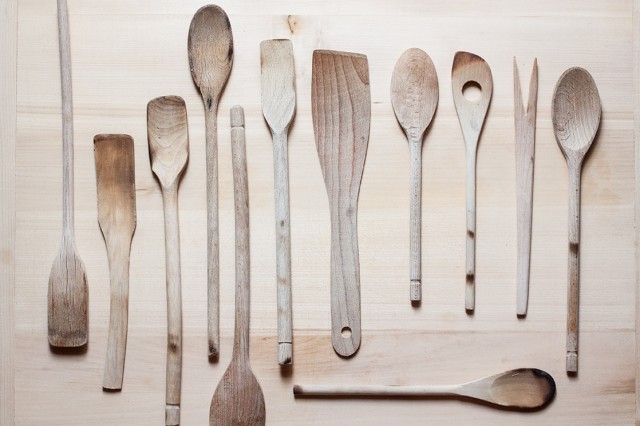
A pair of extra-long chopsticks is one of my favourites. The habit is inherited from my Japanese mother. They work like an extension of your fingers and you can fry, saute, fish things out of boiling pots or serve with them. They’re also very handy for picking up things that have fallen down the back of the oven.
I love wooden spoons and have them in all shapes and sizes; they’re possibly my most-used item next to my knife. I don’t discriminate between them but I do really like this video of Michael Ruhlman on why round wooden spoons are useless in this series on Stupid Kitchen Tools. He has a point (though I still have more round spoons than any other shape). Just recently I realised that the spoons with a hole in the middle have a specific purpose, too — good for risotto (it’s even known as a girariso) or for mixing delicate batters like those for sponge or pastry creams.
A good pair of kitchen scissors is a good idea in theory — I use them for cutting string and chopping parsley over the top of something when I couldn’t be bothered washing a knife and a chopping board. Or like Colwin says, “sewing, cutting the flowers, and opening parcels,” but sometimes I think you can go too far. My Tuscan mother in law has at least three pairs of scissors in her kitchen that she uses for things I had never thought of — cutting pizza slices, mainly, which is common. I have even seen her cutting a huge and hefty bistecca alla fiorentina with them. I still prefer my sharp, heavy kitchen knife and could easily live without scissors.
I did, like Colwin did, end up buying a food mill last year in a second hand shop for a couple of euro. It’s missing the interchangeable plates that allows you to control the size of the grain so my tomato sauce is a bit too chunky, but it is by far one of the best things I’ve been introduced to in an Italian kitchen ever (Rachel Roddy speaks excellently of why they are so good). While I imagine it was invented purely for making passata out of tomatoes, I use it also for pureeing anything from sauces to mashed potato (because Italian kitchens don’t have potato mashers and that is one thing I miss but still haven’t thought it vital enough to buy) to fruit for jam.
In Colwin’s list of kitchen essentials, she notes, “It is wise to keep in mind that pots and pans are like sweaters: you may have lots of them, but you find yourself using two or three over and over again.” But I find looking for really good ones really frustrating because you need to try them on first, like good shoes. You don’t really know how good they are until you’ve tried walking half an hour in them (or cooking a frittata in one, if we’re talking pans) and by then it’s too late to take back to the shop if you decide they’re just not comfortable. I’m still trying to find the perfect affordable pans, but, like shoes, price has a lot to do with it and you do get what you pay for. Splurging on even one pan, I believe, is totally worth it. And it won’t be a frivolous expense, it will be a family heirloom. Some of the best food I have been cooked comes out of the sort of pans that are passed on from generation to generation.
Read more on my article for Food52 on favourite Italian kitchen items. What are your favourite items in the kitchen?